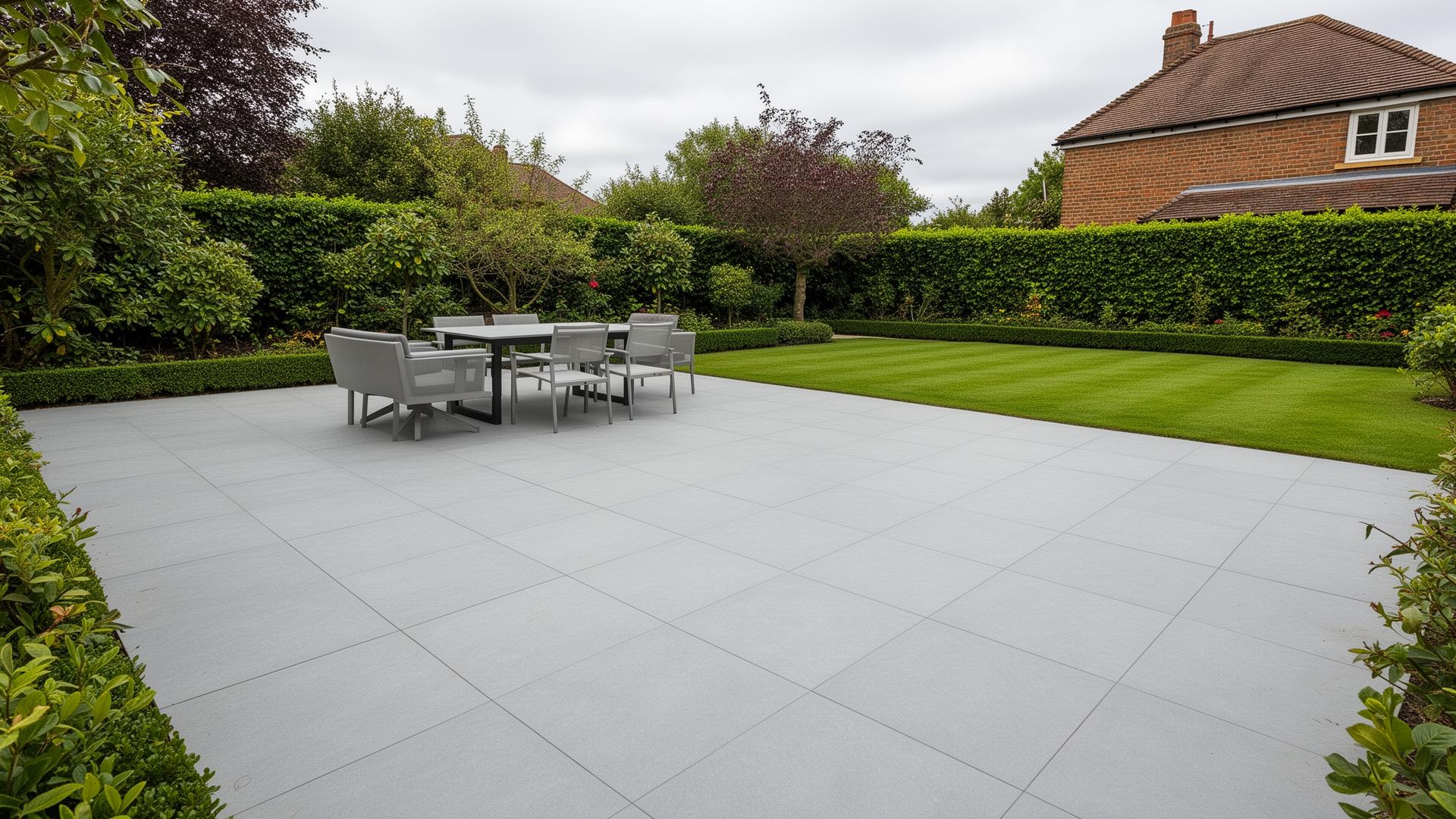
Porcelain, Sandstone & Indian Stone Patios Installed Across the North East
Outdoor entertaining space laid on a full-mortar bed with proper falls, sealed joints and a 1-year workmanship guarantee in writing. Designed once, enjoyed for twenty years.
No filler, no jargon. What you're getting, why you'd want it, and what makes the difference between a good install and a bad one.
What it is
Patios are paved outdoor terraces for entertaining, dining and relaxing, laid on a compacted sub-base, full mortar bedding, with sealed joints and falls designed to shed water away from the house. Material options include porcelain, Indian sandstone, limestone and concrete flag.
Who it's for
Homeowners extending the usable footprint of their property into the garden. Particularly suited to new garden room extensions, hot-tub bases, outdoor kitchens, and traditional dining terraces.
When you need it
When the existing patio is cracked, uneven, weed-ridden, or simply too small. Also when planning a garden room, hot tub or outdoor kitchen, these need a load-rated, properly drained base laid as part of the install.
Why it matters
Because patios fail when they're spot-bedded instead of full-bedded, laid with no falls, or pointed with the wrong mortar. Spot-bedded slabs rock and crack within years; flat patios pond and ice; cement-pointed joints crack and let water under the slab. Done properly, a patio looks brand new fifteen years on.
What Goes Wrong
The mistakes that cost you a re-lay in five years.
We get called in to fix all four of these every month. None of them are accidents, they're predictable consequences of cutting the wrong corner.
Spot-bedded slabs that rock and crack
The cheap way to lay a patio is five mortar dots under each slab, fast, easy, fails within five years. Full-bed mortar takes longer and uses more material; it's the only method that lasts.
Standing water and frost damage
Flat patios pond, water freezes, joints crack and slabs lift. Every patio needs a minimum 1:80 fall away from the house, measured with a level, not eyeballed.
Efflorescence and surface staining
Cheap sandstone leaches mineral salts to the surface as it dries, leaving white efflorescence stains. Premium-grade and porcelain materials don't, and they're a small cost premium up front.
Cement-pointed joints that crack out
Standard mortar shrinks as it cures and cracks at the slab edges within a year, letting water under the patio. We point with flexible polymeric mortar designed for paving, it stays sealed for decades.
Our Process
Five steps. Same on every installation.
01
Design, material selection & quote
On-site measure, material samples on the table, falls and drainage agreed, written itemised estimate.
02
Excavation & sub-base
Excavated to 200mm below finished level, MOT Type 1 compacted in 100mm layers, falls set to 1:80 minimum away from the house.
03
Mortar bed & slab laying
Full-bed 4:1 sharp sand and cement mortar, slabs laid one at a time on a fresh bed, levels checked with a long spirit level and tweaked before set.
04
Joint pointing
Polymeric jointing compound brushed into open joints, watered in, smoothed and cleaned off the slab face before set. Stays flexible for decades, no cracking.
05
Sealing & completion
Sandstone and limestone sealed with a breathable impregnating sealer at month one to protect against staining. Porcelain needs no sealing. Site cleaned, handover walk-through, guarantee paperwork.
The Benefits
Why homeowners across the North East choose this surface.
15–20 year lifespan
Full-bedded slabs with polymeric joints on a compacted sub-base routinely last 15–20 years with minimal maintenance. Workmanship guaranteed in writing for 1 year.
Increased living footprint
A properly designed patio extends the usable area of your property, outdoor dining, entertaining, sun-trap seating. Estate agents put 5–10% uplift on a quality outdoor space.
Stain-resistant porcelain option
20mm porcelain is non-porous, frost-proof, stain-resistant, and never needs sealing. Premium choice for hot tubs, outdoor kitchens, and high-use entertaining areas.
Wide design palette
From traditional Indian sandstone to contemporary porcelain in stone, wood, slate and concrete effects. Borders, contrast strips and integrated step details.
Hot-tub and outdoor-kitchen ready
Patios designed for hot tubs are built on a reinforced load-rated base, we plan for this at design stage if it's on your wish list.
Low maintenance
Annual sweep, occasional jet wash, joint top-up at year 5–7. No re-sanding, no individual block replacement, no re-sealing for porcelain.
The Detail
Everything you'd ask a specialist on the doorstep.
Materials, methods, variations, and the small decisions that separate a 20-year driveway from a five-year one.
Porcelain is the modern premium choice, 20mm vitrified ceramic, non-porous, frost-proof, stain-proof, no sealing required. Indian sandstone is the traditional warm-toned option, available in a wide range of colours from Raj Green to Mint Fossil. Limestone offers a cooler, more uniform finish. Concrete flag is the budget choice, moulded to resemble stone, available in many colours, with a 10–15 year lifespan.
Full-bed versus spot-bed
Every patio we lay is full-mortar bedded, the slab sits on a continuous bed of 4:1 sharp sand and cement, with no voids underneath. Spot-bedding (five dots of mortar per slab) is faster, cheaper, and is the single biggest cause of cracked and rocking slabs on domestic patios. We do not spot-bed.
Polymeric jointing
Standard sand-and-cement pointing cracks within a season as the cement shrinks and the patio flexes. Polymeric jointing compound, a sand impregnated with a polymer binder, stays flexible, fully sealed and weed-free for 10+ years. It's the modern standard for premium patios.
Falls, drainage and the house
Every patio gets a minimum 1:80 fall away from the house wall, with a clear 150mm gap between finished patio level and the damp-proof course of the building. Where the patio meets the house, we either install a linear drain or step the patio down to keep water away from the brickwork. This is plumbing, not landscaping, get it wrong and you bridge the DPC.
Hot tubs, fire pits and load-rated bases
A loaded hot tub weighs 1.5–2 tonnes; an outdoor kitchen base, a pizza oven or a brick BBQ adds significant point loads. Where these are planned, we design a reinforced concrete base or upgraded sub-base into the patio at the start, much easier than retro-fitting later.
FAQs
Straight answers, no sales talk.
Still have a question? Pick up the phone.
How much does a new patio cost?
+
Typical domestic patios across the North East work out between £130 and £200 per square metre installed, depending on material choice, ground conditions, falls and drainage. Porcelain costs more in material but needs no sealing; sandstone is more affordable but benefits from annual maintenance.
Which material lasts longest?
+
Porcelain, non-porous, frost-proof, stain-proof. 25+ years routinely with no surface degradation. Indian sandstone and limestone last 15–20 years with periodic sealing.
How long does installation take?
+
A typical 30–50m² patio takes 4–6 working days from excavation to final clean. Larger patios with steps, walls or integrated features take longer.
Do I need planning permission?
+
Patios at ground level don't require planning permission in most cases. Raised patios above 30cm, or patios within a designated area (conservation, listed) may need consent, we advise on this case by case.
Can you build steps and retaining walls?
+
Yes, integrated steps, raised beds and low retaining walls are standard parts of most patio installations. Anything structural (over 1m retained height) we design with structural engineering input.
Will the patio crack?
+
Not when full-bedded on a compacted sub-base with polymeric joints. The cracking and rocking that gives patios a bad reputation comes from spot-bedding, missing sub-bases and standard cement pointing.
Does porcelain feel cold and slippery?
+
External porcelain is grip-rated R11 or R12, higher slip resistance than wet sandstone and significantly higher than polished internal porcelain. Surface temperature is similar to any stone in shade or sun.
How do I clean and maintain a patio?
+
Annual jet wash on a low pressure, soft-bristle brush for stubborn marks, joint top-up at year 5–7. Porcelain needs no sealing; sandstone and limestone benefit from a sealer refresh every 3–4 years.
Can you remove my old patio?
+
Yes, full lift, removal, disposal and disposal-permit handling are included in the quote when needed. We handle the whole job from existing surface to finished installation.