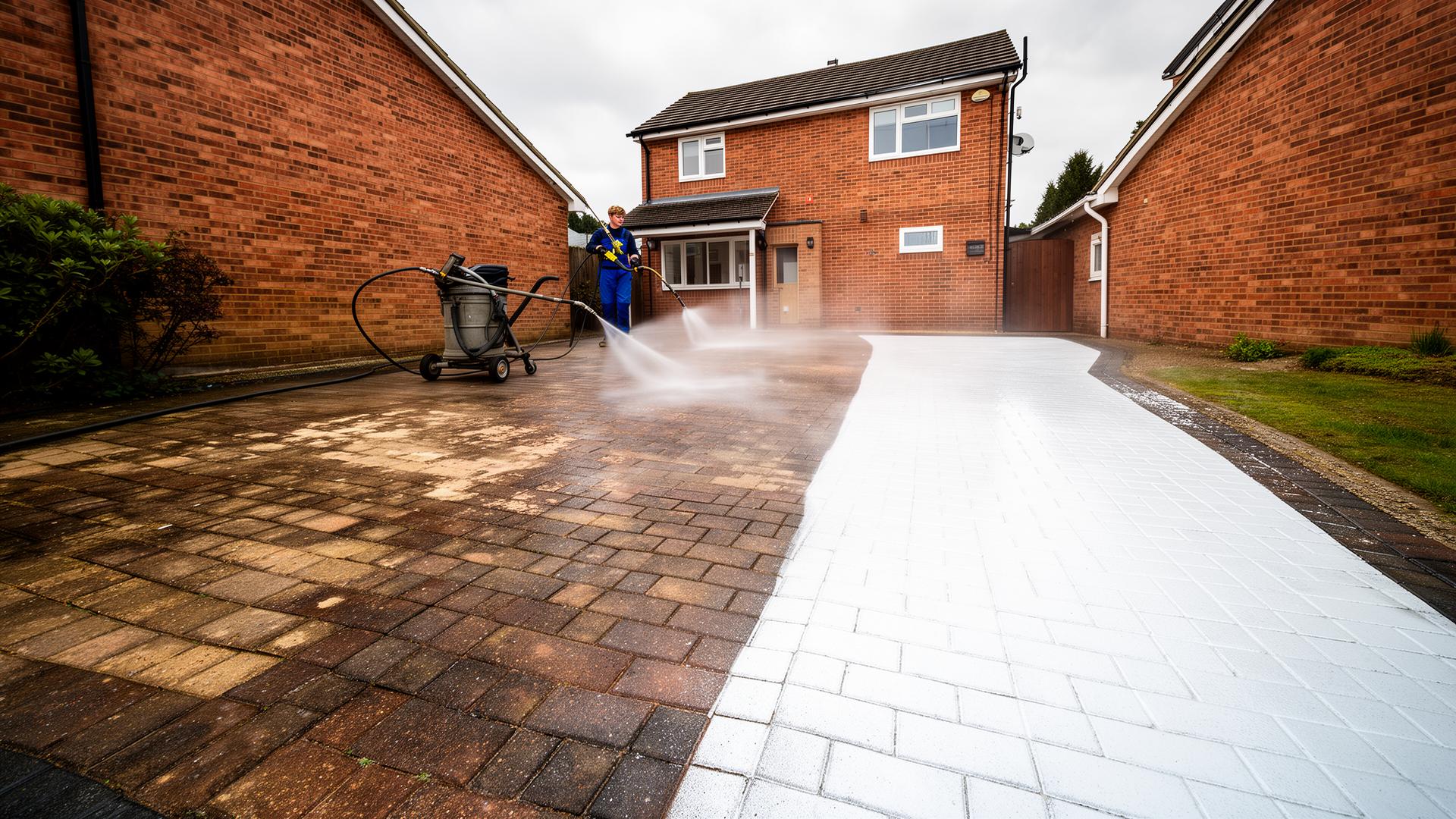
Driveway Cleaning & Restoration Across the North East
Pressure-washing, joint re-sanding, weed treatment and protective sealing, restore your existing driveway to near-new condition for a fraction of the cost of replacement.
No filler, no jargon. What you're getting, why you'd want it, and what makes the difference between a good install and a bad one.
What it is
Driveway cleaning and maintenance is the combination of pressure-washing, joint re-sanding, weed treatment, edge repair and protective sealing that restores a tired driveway without the cost of replacement.
Who it's for
Homeowners with structurally sound but visually tired driveways, typically 5–15 years old, looking grey, weedy or weather-stained. The right service when the bones are good but the surface has gone off.
When you need it
Annually as routine maintenance, or every 3–5 years as a full restoration package. Also before selling the property, a freshly restored driveway returns 5–10× its cost in kerb-appeal-driven offers.
Why it matters
Because driveways collect five years of moss, algae, oil and joint washout invisibly until they look one year older than they are. A two-day restoration takes a tired driveway back to near-new, and protects another decade of life.
What Goes Wrong
The mistakes that cost you a re-lay in five years.
We get called in to fix all four of these every month. None of them are accidents, they're predictable consequences of cutting the wrong corner.
Green algae and black moss
Moss holds moisture against the surface and accelerates joint erosion. Untreated moss spreads season on season and eventually penetrates the block surface itself.
Sunken or washed-out joints
Block paving joints lose sand to wind and rain over the years. Once joints are below the chamfer, blocks start rocking and the structural integrity of the paving collapses fast.
Oil and tyre staining
Engine oil drips, brake-fluid leaks and hot tyre marks penetrate the block surface and stain it permanently if left untreated. Most are removable with the right degreaser and a hot pressure wash if caught early.
Edge erosion and movement
Once the perimeter edge restraint starts moving, usually from skipped haunching or vehicle overrun, the whole driveway begins to creep outward. Spotted and repaired early, it's a half-day job.
Our Process
Five steps. Same on every installation.
01
Site survey
We walk the driveway, identify staining, missing joint sand, weed pressure, edge integrity and any structural movement. Written quote.
02
Pre-treatment
Biocide or weed killer applied 48 hours before cleaning where moss or algae pressure is heavy, kills the root system, not just the surface growth.
03
Pressure wash & rinse
Hot or cold pressure wash at the correct PSI for the surface, too high lifts joint sand and erodes blocks; too low leaves staining. Full clean from edge to edge, then rinsed and allowed to dry.
04
Joint re-sanding (block paving)
Kiln-dried jointing sand swept across the surface, vibrated into the joints with a soft-pad plate compactor, topped up and re-swept. Polymeric joint upgrade available for permanent solution.
05
Sealing & protection
Optional sealer applied at month one (after surface fully dry), colour-enhancing for sandstone and natural stone, satin or matt finish for block paving. Adds 3–5 years of protection.
The Benefits
Why homeowners across the North East choose this surface.
5–10× value versus replacement
A full restoration costs typically £400–£900 on a domestic driveway. Replacement is £4,000–£12,000. When the bones are good, restoration is the better economic decision every time.
Adds 5–10 years of driveway life
Re-sanded joints, sealed surfaces and treated edges add years of life to an existing installation. Routine maintenance is much cheaper than reactive repair.
Instant kerb appeal restoration
A clean, freshly-jointed driveway looks one year younger overnight. Particularly powerful before selling or renting the property.
Removes slip hazards
Wet algae and moss are a serious slip risk on driveways, paths and steps. Pressure-washing and biocide treatment remove the hazard and protect against re-growth.
Detects problems early
A maintenance visit spots edge movement, joint failure, drainage issues and tree-root damage while they're still small jobs, not at the point they need full replacement.
Surface-appropriate techniques
Block paving, resin, tarmac and stone all need different cleaning approaches. We use the right pressure, the right detergent and the right re-treatment for each surface, not one-size-fits-all.
The Detail
Everything you'd ask a specialist on the doorstep.
Materials, methods, variations, and the small decisions that separate a 20-year driveway from a five-year one.
Block paving cleans best at 2,000–2,500 PSI with a rotating turbo nozzle. Resin bound needs much lower pressure (1,200–1,500 PSI) and a fan jet, too high and you strip the surface aggregate out of the binder. Natural stone (sandstone, limestone) needs a soft-wash approach with biocide and lower pressure to avoid surface etching. One-size-fits-all wash kills surfaces, we set the kit for the surface.
Joint re-sanding versus polymeric upgrade
Standard kiln-dried sand is the original block paving jointing material and remains the cheapest option. Polymeric jointing compound, sand impregnated with a polymer binder, costs more, takes longer to install, and stays in the joints for 10+ years with no weed pressure. For driveways being restored for the long term, polymeric is the better investment.
Sealing, what it does and doesn't do
A driveway sealer protects against staining, slows joint sand erosion, deepens colour, and adds a satin or matt sheen. It doesn't make a driveway maintenance-free, doesn't fix structural problems, and needs reapplication every 3–5 years. On premium-grade block paving and resin, sealing is optional but adds visible value; on cheap concrete blocks, it's not worth the spend.
Weed control, surface versus root
Surface weed killers (glyphosate, acetic acid) kill the leaves but leave the root system to re-grow. Long-term joint weed control needs root-deep biocide treatment plus joint re-sanding to remove the growing medium. Polymeric jointing compound is effectively weed-proof for the first 8–10 years.
When restoration won't fix it
We won't sell you a clean if your driveway needs a re-lay. If the sub-base has failed, the edges have collapsed or the surface is structurally compromised, restoration is throwing money at a problem that needs proper repair. We'll inspect honestly and tell you which one your driveway needs.
FAQs
Straight answers, no sales talk.
Still have a question? Pick up the phone.
How much does driveway cleaning cost?
+
A typical domestic driveway clean and re-sand works out between £250 and £600 depending on size, surface and condition. Add £150–£350 for premium sealing. Every quote is itemised in writing.
How often should I have my driveway cleaned?
+
An annual light clean keeps moss and algae under control. A full restoration (clean, re-sand, seal) every 3–5 years protects the surface long-term.
Will pressure washing damage my driveway?
+
Not when done at the correct pressure for the surface. Excessive pressure on resin bound strips aggregate; on natural stone it etches the face. We set the kit to the surface, every time.
Can you remove oil stains?
+
Most oil staining lifts with a hot pressure wash and the right degreaser, particularly if caught within the first few weeks. Deep, old oil staining may leave a faint shadow on block paving; sealing afterwards minimises this.
Will weeds come back?
+
Yes, eventually, wind-blown seed germinates in any joint over time. Standard kiln-dried sand needs annual top-up treatment; polymeric jointing compound stays weed-free for 8–10 years.
How long does a clean take?
+
Most domestic driveways are cleaned and re-sanded in one full working day. Add a day for sealing (after the surface has fully dried, typically 24–48 hours).
Do you do resin and porcelain too?
+
Yes, different products and pressures, but the principles are the same. We clean resin bound annually for clients who want it kept looking near-new, and porcelain patios as needed.
Can you fix sunken blocks at the same time?
+
Yes, we lift, re-bed and re-lay sunken or rocking blocks as part of the restoration package. Small numbers (under 20 blocks) usually included in the clean quote; larger repair work itemised separately.
Do I need to be home?
+
Helpful at the start to walk the job and at the end to inspect, but not essential. Most clients leave a key or a side gate unlocked.