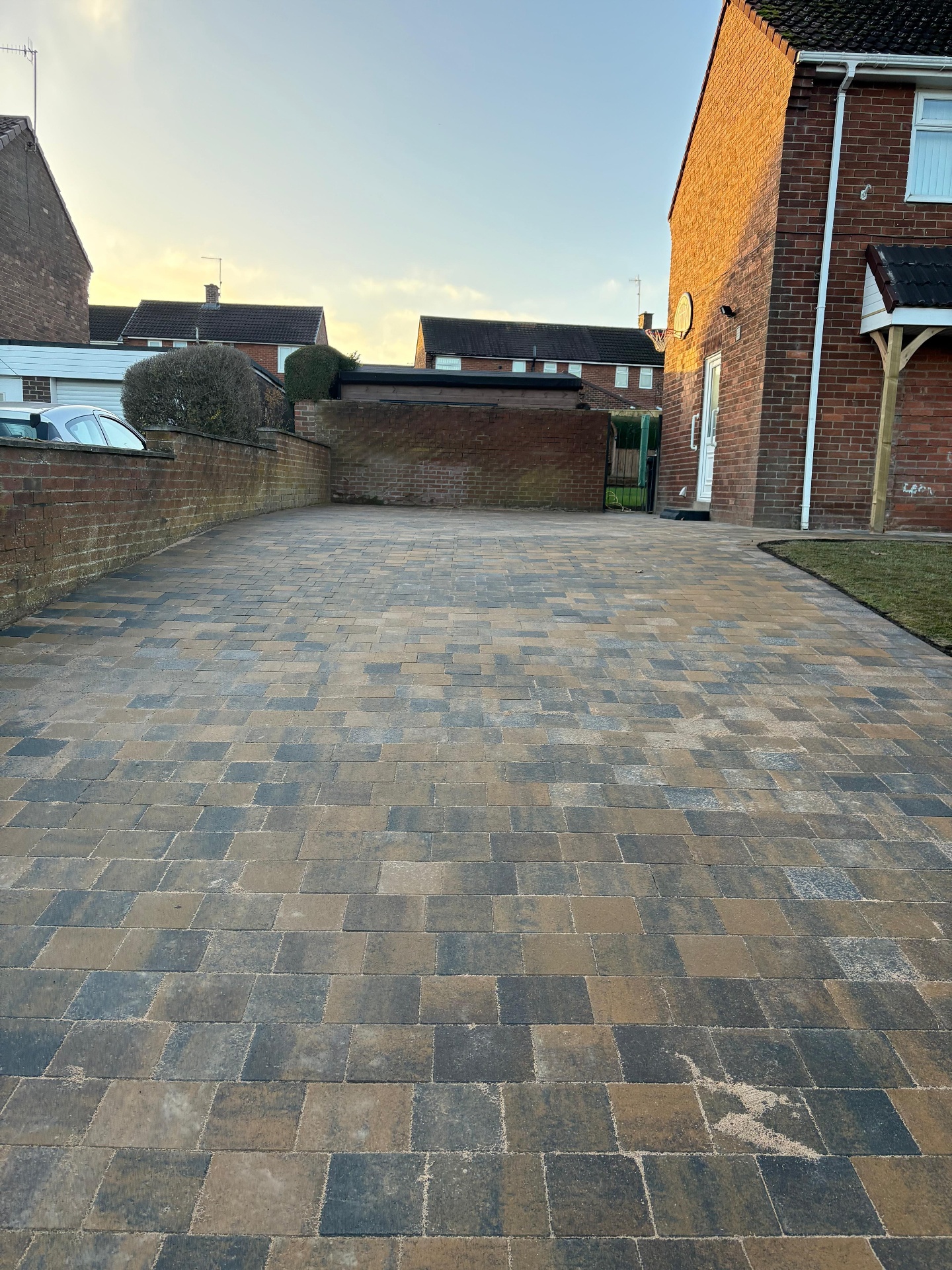
Block Paving Driveways Hand-Laid Across Durham & the North East
Classic, hard-wearing block paved driveways and patios in herringbone, stretcher and basket-weave. Laid on a 150mm sub-base with crisp edge restraints and proper drainage, finished to last thirty years.
No filler, no jargon. What you're getting, why you'd want it, and what makes the difference between a good install and a bad one.
What it is
Block paving is concrete or clay paviours laid in interlocking patterns over a compacted sub-base and sand bedding layer, kiln-dried sand swept into the joints. Done correctly, it carries vehicle loads for thirty years with minimal maintenance.
Who it's for
Homeowners who want a traditional, characterful finish with the option of contrasting borders, decorative inlays and lifetime-replaceable individual blocks. The right choice for properties where the architecture calls for detail, pattern and texture.
When you need it
When you want a driveway that handles repeated vehicle loading, occasional repair-and-relay, and a wider design palette than resin or tarmac. Also the strongest choice where heavy vans, motorhomes or trailers regularly use the driveway.
Why it matters
Because block paving lives or dies on the sub-base, the bedding and the edge restraints. Skip any one and you get the rocking, sinking, weed-infested blocks that give the product its bad reputation. Lay it properly and it outlasts the house owner.
What Goes Wrong
The mistakes that cost you a re-lay in five years.
We get called in to fix all four of these every month. None of them are accidents, they're predictable consequences of cutting the wrong corner.
Rocking blocks and sunken patches
Almost always traceable to a thin or uncompacted sub-base. Once individual blocks start moving, joint sand washes out and the failure spreads outward fast.
Weeds growing through every joint
Caused by poor jointing technique, sand not properly swept and compacted, or polymeric sand used in the wrong conditions. Weeds in joints are a symptom, not the disease.
Edges that creep outward
Without a proper concrete-haunched edge restraint, the perimeter blocks splay outward under vehicle load. Once the edges go, the centre follows.
Cheap concrete blocks that fade and chip
Trade-grade concrete paviours from a builder's merchant lose their colour within a few summers and chip on the leading edge. Premium-grade Marshalls, Brett and Tobermore blocks hold their colour and chip resistance for decades.
Our Process
Five steps. Same on every installation.
01
Survey, design & quote
On-site measure, pattern and colour selection, drainage check, and a fully itemised written estimate.
02
Excavation & sub-base
Excavated to 200mm, MOT Type 1 laid in 100mm layers and compacted with a heavy-plate vibratory compactor.
03
Edge restraints
Perimeter edging set on a wet concrete haunch, the structural backbone that stops the whole driveway creeping outward.
04
Bedding & block laying
30mm of sharp sand screeded level. Blocks hand-laid in your chosen pattern, cut tight to edges with a wet-saw, no straight runs against the edge.
05
Jointing & compacting
Kiln-dried jointing sand swept in, blocks compacted with a vibratory plate fitted with a soft-pad, joints topped up, surface swept clean and walkable immediately.
The Benefits
Why homeowners across the North East choose this surface.
30-year lifespan
Properly laid block paving routinely lasts thirty years on a domestic driveway. Individual blocks can be lifted and replaced in minutes.
Heaviest load capacity
The interlocking action of block paving spreads point loads across the whole surface, the right choice for vans, motorhomes and trailers.
Repairable in sections
Unlike resin or tarmac, individual damaged blocks can be lifted and replaced without any visible patch line. Keep a few spares with the original delivery.
Design flexibility
Herringbone, stretcher bond, basket weave; contrast borders; decorative inlays; tactile crossing strips. Block is the most versatile design palette of any driveway finish.
Established kerb appeal
Traditional, recognisable, premium. Block paving reads as quality at first glance, particularly for period and traditional properties.
Permeable options
Permeable block paving with open joints over a permeable sub-base meets SuDS requirements with no planning consent needed.
The Detail
Everything you'd ask a specialist on the doorstep.
Materials, methods, variations, and the small decisions that separate a 20-year driveway from a five-year one.
45° herringbone is the strongest pattern under vehicle load and the one we recommend for driveways. 90° herringbone, stretcher bond and basket weave look excellent on patios and pedestrian areas. Contrasting borders in a single-block or double-block frame lift the whole installation and let us cut tight, clean perimeter lines.
Block grades, what to specify
We work primarily with Marshalls Drivesett Argent, Tegula and Tegula Priora; Brett Omega and Alpha; and Tobermore Sienna and Tegula. These are the kiln-fired, colour-through, premium-grade concrete paviours that hold their colour and edge integrity for decades. We don't lay budget trade blocks, the price gap on a typical drive is small, and the lifespan gap is enormous.
Permeable block paving and SuDS
Permeable paving uses specially shaped blocks with wider joints, filled with clean grit instead of kiln-dried sand, laid over an open-graded sub-base. Surface water drains through the joints, through the sub-base and into the ground, meeting SuDS requirements and avoiding the planning consent required for impermeable front-garden surfaces above 5m².
Edging, drainage and falls
Every block driveway gets a concrete-haunched edge restraint, kerb sets, header courses or a hidden concrete edge depending on the design. Falls are set at 1:60 minimum to direct surface water to a linear drain, soakaway or permeable strip. Bad falls and missing drainage are why driveways flood, not the block itself.
Residential and commercial differences
Domestic block paving uses 50mm or 60mm paviours; commercial forecourts and heavy-load areas step up to 80mm. The principles, sub-base depth, edge restraints, herringbone laying pattern, are identical, just scaled up. Most of our work is residential; we take on small commercial jobs where the site suits.
FAQs
Straight answers, no sales talk.
Still have a question? Pick up the phone.
How much does block paving cost in Durham?
+
Typical domestic block paving works out between £85 and £130 per square metre fully installed, depending on block choice, pattern complexity, edging and drainage. Every estimate is itemised in writing.
How long does block paving last?
+
30 years routinely on a properly laid driveway. Workmanship is guaranteed for 1 year in writing; the manufacturer's block warranty typically runs to 10 years on colour and structure.
Will weeds grow through the joints?
+
Not for the first several years if the jointing is done correctly, kiln-dried sand swept and vibrated in, joints topped up after a few weeks. Annual joint maintenance keeps them clean for the long term.
Can you repair an existing block paved driveway?
+
Yes, we re-lay sunken or rocking sections, replace damaged blocks, re-sand joints and re-haunch failing edges. We'll inspect and quote honestly on whether repair or replacement makes more sense.
Which pattern is strongest?
+
45° herringbone. The interlocking action spreads vehicle point loads across multiple blocks. 90° herringbone is nearly as strong; stretcher bond and basket weave are best kept to pedestrian areas.
Do I need planning permission?
+
Standard impermeable block paving over 5m² in a front garden requires planning if surface water drains to the road. Permeable block paving, or impermeable with a French drain to a soakaway, does not. We design within permitted development rules by default.
How long does the installation take?
+
A typical 50–80m² domestic driveway takes 4–6 working days from excavation to clean-up. Larger or more complex installations 7–10 days. You'll have a firm schedule in writing before we start.
What if a block gets damaged?
+
Individual blocks can be lifted with a pair of paving keys and replaced in minutes. We leave you with spare blocks from the original pallet at completion.
Is block paving cheaper than resin?
+
Slightly, in most cases, but the cost difference closes once you factor in long-term maintenance. Block paving needs occasional re-sanding and weed treatment; resin bound is essentially maintenance-free.